
It is a hot Thursday morning in Walewale, with the sun out and blazing. Asana has been waiting for several hours at the clinic for medicine that is not forthcoming. The nurse comes out and tells her that the supplies have just “run out again.” Meanwhile, a few hundred kilometres away, headlines have broken about another government scandal, with millions gone and unaccounted for. Asana may never read that report, but she lives its consequences every single day.
Corruption is a menace that robs us of our resources and creates significant hindrances to Ghana’s development. This is why, at BudgIT Ghana, we believe that informed citizens are powerful, and have thus made it our mission to simplify public spending and spur action toward greater accountability.
The recent string of high-profile scandals, as reported by the Attorney General, highlights a pervasive pattern of misappropriation that has cost our nation billions.
The Shocking Numbers: Over GH₵129M Lost in Recent Scandals
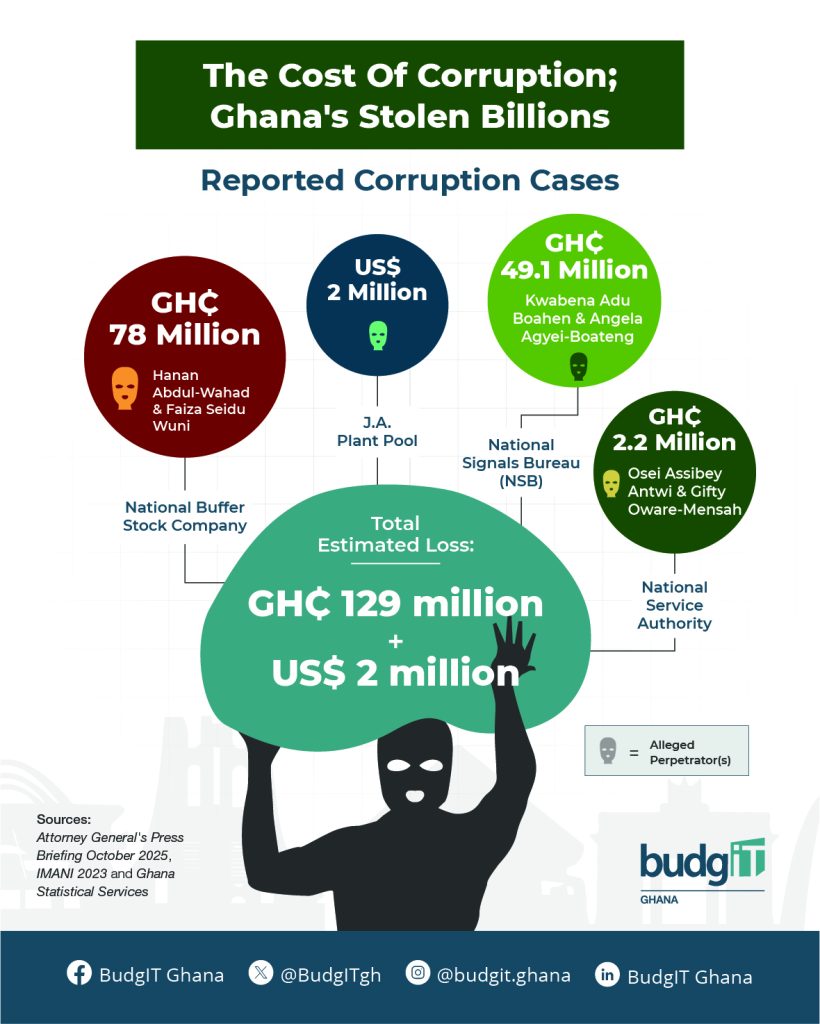
The recent scandals at three state institutions, the National Signals Bureau (NSB), the National Service Authority (NSA), and the National Buffer Stock Company, resulted in the state losing funds in excess of GH₵129 million and an additional $2 million.
See here for more information: Attorney General’s Press Briefing
The Human Cost: Where Your Money Could Have Gone
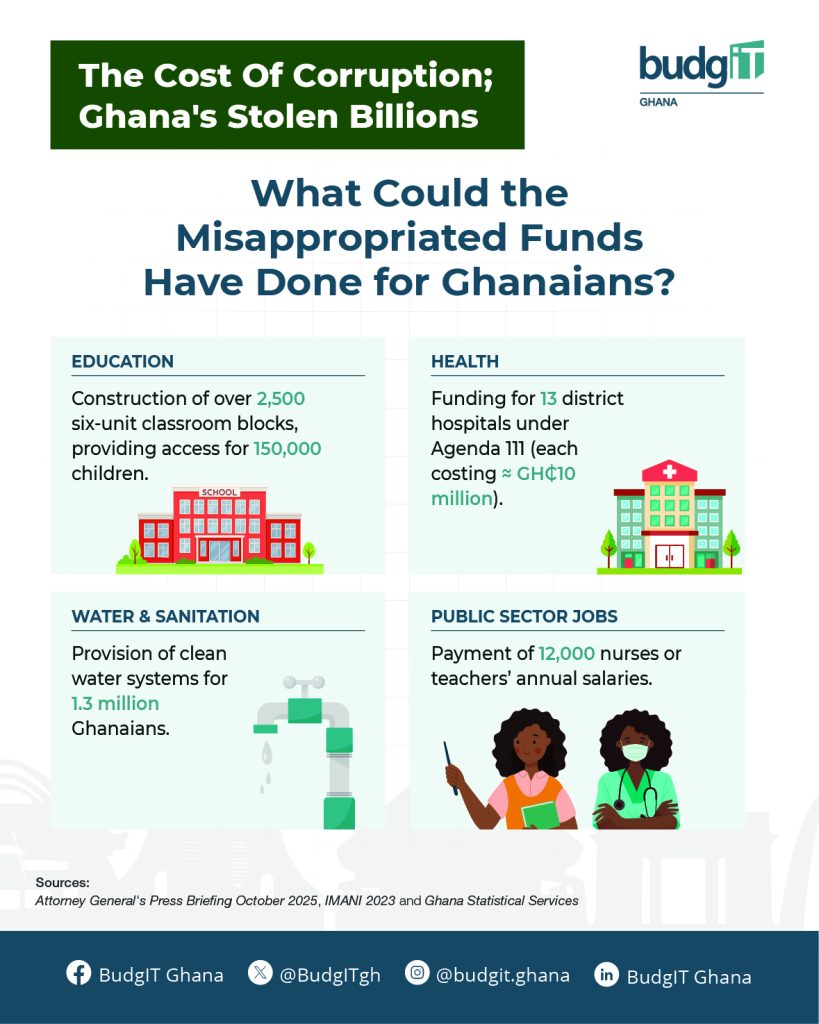
Corruption is the reason why vulnerable children go to bed hungry and why regional hospitals lack life-saving equipment. In fact, the projects that could have been funded with the reportedly stolen GH₵129 million serve as a clear example of the actual trade-offs in corruption. If well utilised, stolen funds would transform lives across Ghana. Imagine 150,000 children learning in new classrooms, 13 district hospitals built and fully equipped under the Agenda 111 initiative, and 12,000 nurses or teachers receiving their annual salaries on time. All these are the futures, livelihoods, and hopes lost to corruption.
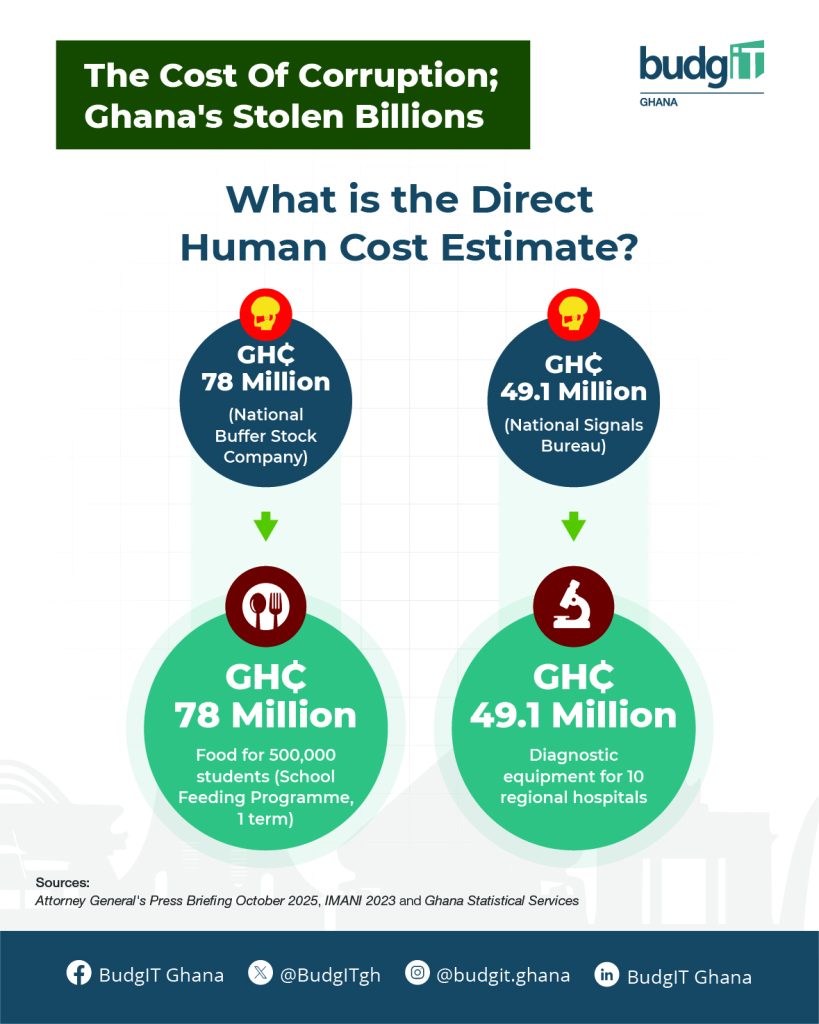
Consider what GH₵78 million lost at the Buffer Stock Company could do. It would have been sufficient to feed 500,000 students under the School Feeding Programme for a whole school term, or the GH₵49.1 million from the NSB, which could have been used to equip 10 regional hospitals with modern diagnostic machines, thereby improving access to quality healthcare. Every cedi stolen means fewer services and reduced development opportunities.
The Taxpayer’s Burden: A GH₵1,440 Annual Surcharge
Every household in Ghana bears the cost of corruption. The Ghana Statistical Service (GSS, 2024) estimates that the indirect costs of corruption, including those associated with poor service delivery and inflation, amount to GH₵1,440 every year for the ordinary household.
In the words of IMANI Africa in 2023, “Every single GH₵100 lost to corruption could have at least devoted GH₵30 to basic education or health care”. This is not only a setback to development but also reinforces inequality.
Call to Action: It is Time for Citizen Oversight
What Can You Do?
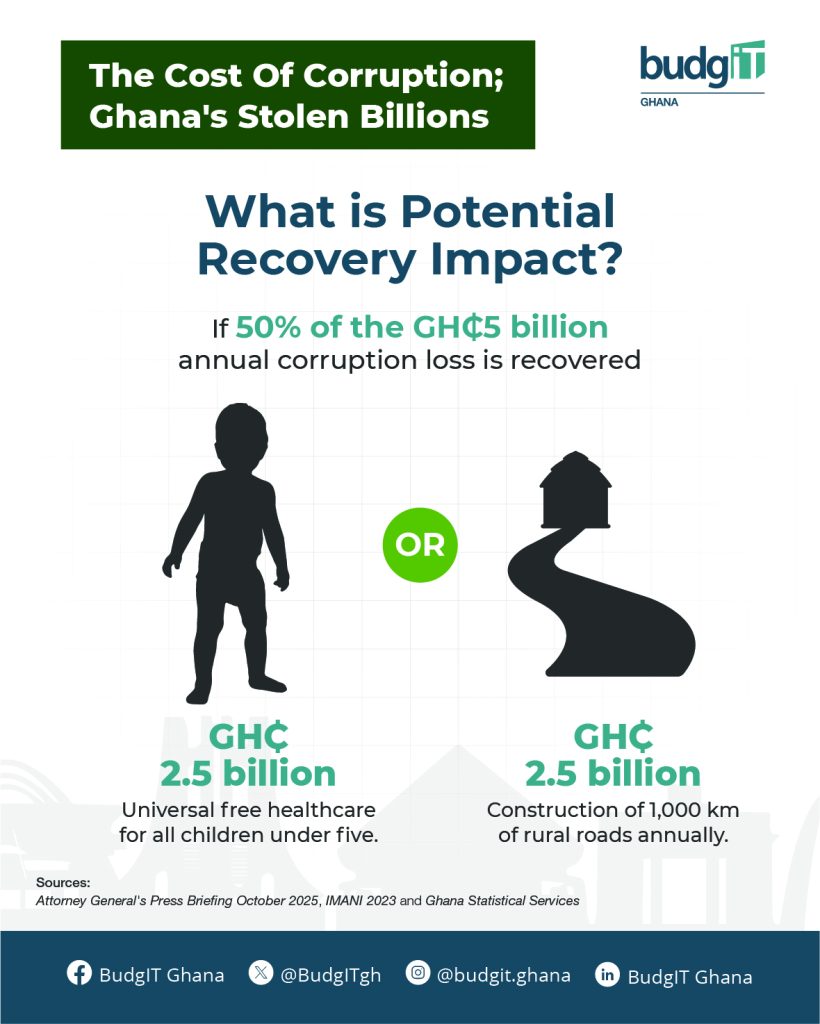
Transparency and accountability are not just governance ideals, but development imperatives. If Ghana were to recover half of the GH₵5 billion lost every year due to corruption, this amount would cover universal free healthcare for all children under five years old or the construction of 1,000 km of rural roads annually.
Every Ghanaian citizen has the power to be an agent of change. One way to do this is by registering on the Tracka platform, BudgIT’s citizen-led project monitoring platform. As the name suggests, citizens can use the Tracka platform to track all government projects within their communities, give updates on the progress of these initiatives, upload photos and report on projects that have been abandoned or poorly executed. This direct participation will ensure that the authorities are kept on their feet, held responsible for the commitments they make and that public funds are directed where they are needed most.
Again, citizens can also go a step further by becoming Community Champions. These are individuals who mobilise their neighbourhoods to discuss issues of budget transparency, monitor development projects, and advocate for better service delivery. By leading such discussions, these champions act as bridges between local communities and the institutions meant to serve them.
Also, supporting or becoming a member of local advocacy groups, such as community-based organisations, youth groups and concerned citizens coalitions, among others that focus on issues of transparency and anti-corruption, would provide a collective voice that can promote the demand for good and honest governance. Through a collaboration of this form, citizens can translate their frustrations into organised action that will strengthen the push for reforms that would really serve public interest.
BudgIT Ghana continues to insist on open data, fiscal transparency, and active citizen oversight. We must all become ‘community champions’ in demanding answers from our leaders.
“Every cedi saved rebuilds the nation.”
Hamid Abdel-Mumuni writes from the BudgIT office in Ghana