
There is a particular danger in arriving late to a technological revolution; you can spend so much time learning how to use what others have built that you forget to ask who owns the infrastructure, writes the rules and decides where the road leads. Africa has been here before. We have often entered technological revolutions as enthusiastic adopters adapting our economies, our institutions, and ambitions around systems whose underlying architecture, data and rules were largely designed elsewhere. Artificial intelligence brings that old dilemma into sharper focus – and the stakes are considerably higher. The World Bank’s 2026 Development Report describes AI as a potential lifeline for developing economies, noting that AI could help them achieve in a decade what might otherwise take a century; yet the same report warns that many developing countries still lack the power, connectivity, skills, data and institutions necessary to use it effectively. The imbalance is already stark. Less than 2% of the world’s data-centre capacity is located in Africa, while only about 5% of African AI innovators have access to the computing power they need. And this is not merely a technology problem; Africa has the world’s youngest and fastest growing population, yet roughly 10-12 million young people enter its labour force each year while the continent creates only about 3 million jobs annually, according to the World Bank. For a continent with this demographic reality, AI is not some distant Silicon Valley conversation. It could reshape who gets work, who gets opportunity, who can build businesses, how healthcare is delivered, how governments function, and whether millions of young people are equipped to participate in the economy of tomorrow – or simply watch it happen. So the question confronting Africa is no longer whether we will adopt AI. We will. The harder, more consequential question is whether we will remain consumers of technologies built elsewhere or become active participants in building, adapting, governing, telling the stories and owning the systems that will increasingly shape our lives. That is the question that gave birth to the maiden edition of the Nyansa Futures 2026 Convening, capped on the theme, “From Adoption to Ownership; Shaping Africa’s AI Future.”
Getting Beyond the Hype
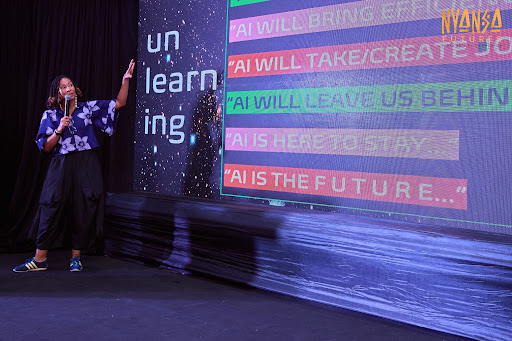
Convened as part of the Beyond AI Initiative by IT think-tank Aether Strategies, with partners including BudgIT Ghana, RD Technologies, Hibane AI, Bilili Creative Lab, Congo Love, the Accra Digital Centre and Ghana Digital Centres Limited, Nyansa Futures was designed to move beyond the hype and familiar excitement around AI – the impressive demos, futuristic promises and inevitable declarations that AI is the future – and actually interrogate the systems, choices, and power structures beneath the technology. It created room for the harder questions; Who gets access? Who gets to build? Whose data trains the systems? Who benefits from the value they create? Who is excluded? Who owns the infrastructure? Who writes the rules? And ultimately, who gets to imagine the future in the first place? These questions are particularly consequential for Africa where uneven digital access, limited infrastructure, skills gaps, fragile labour markets, and institutional constraints already shape who gets to participate in the digital economy. Nyansa Futures was structured to explore how the choices made now could allow AI to widen existing inequalities or become a powerful instrument for expanding opportunity, strengthening public systems, and giving millions of young people greater agency over their economic and civic futures.
From Users to Builders
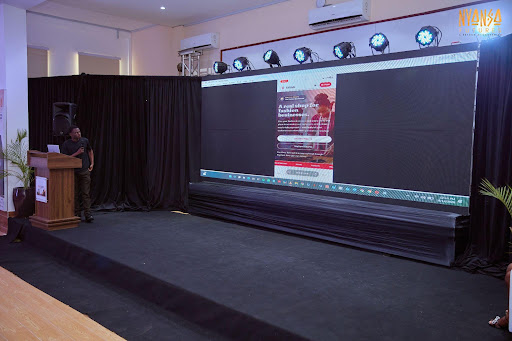
Some of the most powerful evidence that Africa’s AI and technology future can be different came not from a multinational tech company during the conference, but from young Africans already building solutions to the problems they find around them. Participants and stakeholders at NyansaFutures saw that reality on full display during a showcase part of the conference. Daniel Nana Kwadwo Baah, a Computer Science Student at the Academic City University, presented Xtiich, a multi-tenant commerce operating system designed for Ghana’s fashion businesses- an ambitious attempt to give an industry that is often fragmented the digital infrastructure to sell, manage and grow more efficiently.
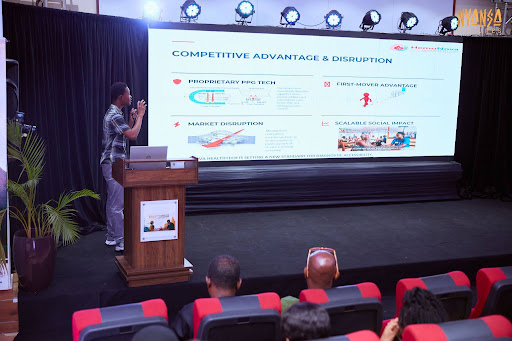
Then came Israel Bagonluri, a level 100 Biomedical Engineering student at Academic City University, who introduced the room to Hemanova, a health tech product that is pushing the boundaries of healthcare technology with a vision for transforming how conditions including anemia and sickle cell are diagnosed. The significance of this part of the conference went beyond the products themselves; here were young people not waiting for someone to hand Africa a technological solution to these problems; they were imagining, experimenting and building for African realities now. As an organisation very much involved in the work of health sector accountability and the informal economy, many of whom were fashion entrepreneurs, the work of these young people was a clarion call to rethink the familiar narrative that Africa’s innovation story is one of blind consumption and capitalist realities but that the talent to change things were already sitting in classrooms. What was left was to provide the ecosystem; opportunity, mentorship, investment, technical support, infrastructure to turn these ideas into something that could survive beyond prototype.
The Power Behind the Technology
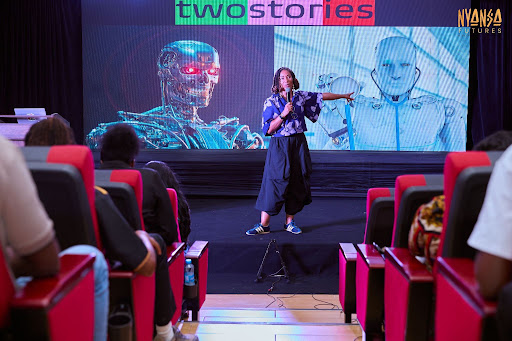
Princeton Professor, Dr. Ruha Benjamin, pushed the conversation into deeper and more uncomfortable territory, challenging participants to look beyond AI’s dazzling capabilities and interrogate the systems of power, inequality and human choice embedded within the technologies we are often so eager to embrace. Her masterclass was hinged on one key theme; that technology is never simply technology. She explained that every algorithm is an amalgam of choices, every dataset reflects decisions about what is collected, what is missing and whose reality is considered worth capturing. Every technological system carries the assumptions, priorities and values of the people and institutions behind it, and when those systems are deployed at scale, those seemingly technical choices can determine who gets access to opportunities, who is visible to institutions, whose problems get shafted, therefore for Africa, this makes the AI conversation more consequential than a race to acquire the latest tools. The harsh truth is that if Africa is absent from the imagination of the future, we may eventually find ourselves living inside somebody else’s idea of what our future should look like.
The Nyansa Panels; a Buffet of Questions
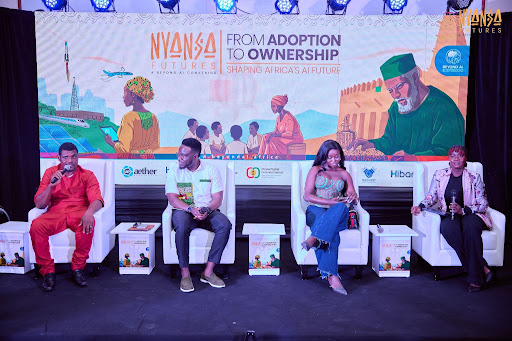
Perhaps the best part about Nyansa Futures was that it did not romanticise innovation. The panels were tailored to take the conversations beyond innovation and into the questions about the reality of benefits and terms. Across the roundtables and fireside chats, participants and speakers wrestled with necessary questions; Is AI primarily for the People or really for the Powerful?; Who should govern Africa’s AI Future?; AI, virtual assets and the digital economy; who owns the rails?; Can Africa build AI on its own terms?; What must Africa build, govern and own? The answers to these questions ultimately will require more than ambition; it will involve targeted investment in talent, infrastructure, data, research, and public policy.
Africa Must Tell Its Own AI Story
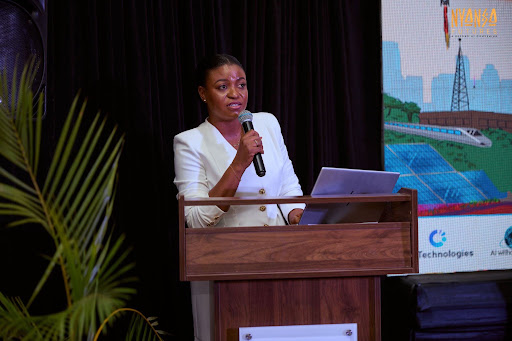
The Special Guest Of Honour, Hon. Ama Pratt, Press Secretary and Spokesperson of the Vice President of the Republic, in her keynote address on who tells Africa’s AI story added another dimension to the conversation. For generations, Africa has been described in the narratives of what it lacks; the development gap, the infrastructure gap, the technology gap, but she indicated that the African AI story cannot simply be another chapter in that narrative. Africa must also be able to tell its own stories about what it creates, contributes and solves; however this would require not only changing how the world sees African innovation, but how Africans see themselves within it. Young people should not encounter AI as something that belongs to Silicon Valley or Shenzhen or some distant technological frontier.
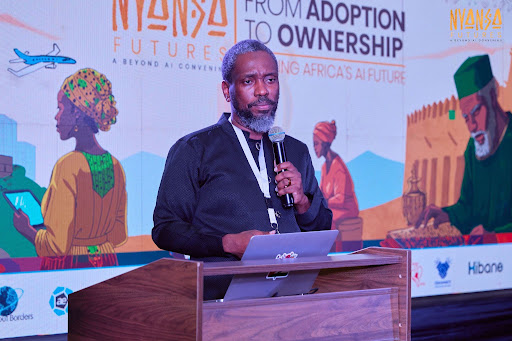
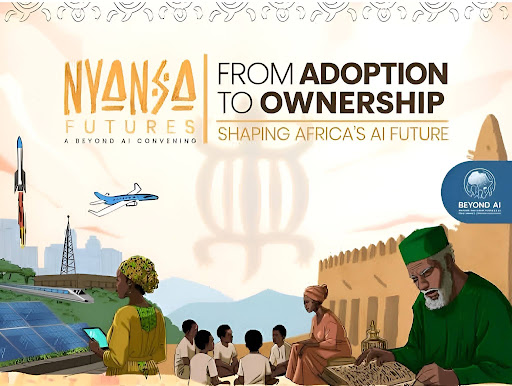
In his interpretation of the Nyansa Futures flagship theme design, Dr. Kambale Musavuli, the Managing Director of Aether Strategies and the brain behind it all, stated that the visual message is a bridge between Africa’s inheritance and technological future. The Timbuktu Library evokes Africa’s long tradition of knowledge, scholarship and information, an ancestral parallel to the data centres of today, while the Larabanga Mosque and the cleric and the circle of women and children represent wisdom (Nyansa), belief systems, oral tradition, and the African tradition of transmitting knowledge through storytelling and community. On the other side, the woman with the tablet, solar panels and futuristic cityscape represented today’s world of technology, data, innovation and digital possibility. The Denkyem (crocodile) sitting at the centre, was an emblem of adaptability, capable of exiting in both water and on land, symbolising Africa’s ability to harness technology through the lens of our own history, context, culture, realities rather than adapting to someone else’s idea of technological progress.
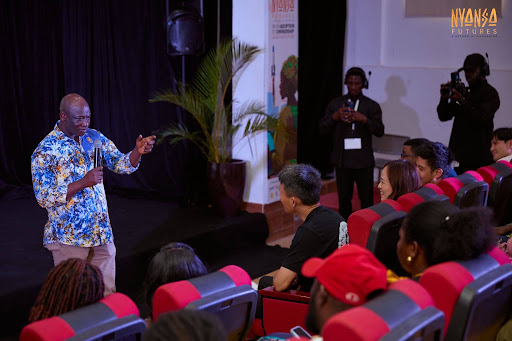
Ghana’s AI Outlook and BudgIT Ghana’s Work in Bridging Civic Action with Technology
Hon. Dr. Abednego Bandim, Chairman of Ghana’s Parliamentary Committee on Information Technology, in his address to the room, spoke to the urgent need for Ghana’s laws to keep with AI and emerging technologies. He highlighted the need to strengthen data protection, digital governance and AI regulation as Ghana advances its digital transformation. With new legislation on AI, data governance and emerging technologies expected before Parliament, the challenge is building a framework that protects citizens without stifling innovation.
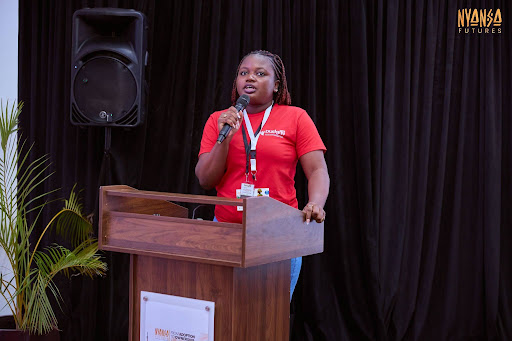
As an official sponsor and partner on the Beyond AI Initiative and the Nyansa Futures Convening, BudgIT Ghana brought its civic-tech experience to the conversation exploring how technology and AI can deepen citizen engagement and strengthen accountability. Through platforms like Tracka, we already see how digital tools can help citizens understand, monitor and influence what happens in their communities. Our participation represents a shared belief that technology should not only make systems smarter, it should also make citizens more informed, empowered and able to shape the systems around them.
Perhaps the most important lesson from this year’s edition of Nyansa Futures is we must move from adoption to ownership, not later, in the near future, now. Africans do not need another conversation about technology being the future. We already know. What we need are conversations that help us determine what kind of future we want, whose interests it should serve and what we must build today to make that future possible.