
Introduction
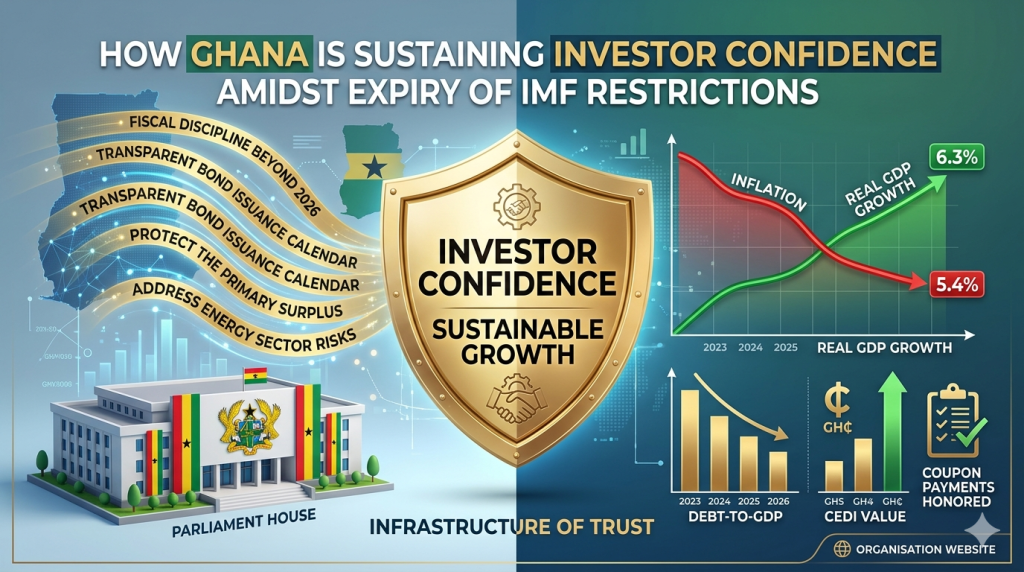
On March 2, 2026, Ghana’s Ministry of Finance announced that the ban on new domestic bonds that had been in place for the past three years had expired. The ban was instituted in 2023 after the debt default that led to the Domestic Debt Exchange Programme (DDEP) in the country. This move marks a significant turning point in Ghana’s fiscal journey, allowing the government to shift from reliance on short-term Treasury bills to long-term domestic bonds. The moment could not have been a more opportune time, given that inflation was at a record low of 5.4% in December 2025, the lowest since July 2022; the Cedi was up by 30% in value; and real GDP growth was at 6.3% in the first half of 2025. It is therefore a delicate process for the country to re-enter the domestic market after a restructuring period. Studies have shown that DDEP had a strong, statistically significant effect on investor confidence, with investors pricing in a “confidence discount” in sovereign debt. To sustain the trust that the reset agenda in 2025 has begun to rebuild, policy interventions must be deliberate, institutionalised, and informed by data.
The Rollover Problem that Bond Issuance must address
For three years, the government of Ghana relied almost entirely on short-term financial instruments. Since the 2023 domestic debt restructuring, Ghana has only issued Treasury bills that mature within a year. As of November 2025, the average time before these bills mature is less than three months. This has created a dangerous imbalance in the country’s financial structure. The reliance on short-term Treasury bills increased considerably during the restructuring period, heightening the state’s exposure to rollover risks and increasing short-term borrowing pressures.
Every few weeks, the government had to return to the market to refinance its maturing debt, accepting whatever interest rates investors demanded at the time. When confidence weakens, those rates surge. By the end of 2024, the interest rate on a 91-day Treasury bill reached 28.04%, and the 364-day Treasury bill reached 30.07%. At this time, interest rates were already consuming a large share of government funds, worsening financial pressure.
To mitigate this risk, the Medium-Term Debt Management Strategy (MTDS) for 2025–2028 now establishes specific benchmarks: Treasury bills should not exceed 20±5% of domestic debt, debt maturing within a year should not exceed 15±5% of total debt, and the average time to maturity should be at least eight years. These are the projected targets; however, how and whether the government can maintain its current course are the questions.
What Sustaining Confidence Actually Requires
Investor confidence is not an emotional phenomenon. It is linked to institutional behaviour, credible and verifiable data, and consistent policies. Ghana has demonstrated this on three fronts: consistent coupon payments since 2025, a better-than-forecast primary surplus, and upgrades from Fitch, Moody’s, and S&P. The IMF stated that a continued decline in inflation, coupled with a carefully planned easing cycle, is likely to boost consumer confidence, credit conditions, and private-sector investment in 2026. However, they also pointed out that additional institutional reforms are crucial to lock in these gains.
Ghana must take the following steps to maintain its position:
- Maintain fiscal discipline beyond the IMF programme.
First, maintain fiscal discipline beyond the IMF programme. The Ghana-IMF Extended Credit Facility is scheduled to expire in May 2026. The true test will be what comes next. In Ghana’s history, there have been several instances where fiscal management deteriorated after completing programmes, with the drivers being, but not limited to, overspending before elections, revenue undershooting, and domestic borrowing rising sharply. The government’s fiscal policy must be underpinned not just by IMF programmes, but also enshrined in law. The amendments to the Fiscal Responsibility Act and the creation of a Fiscal Council are laudable; however, discipline and strict adherence to the provisions of these acts are what will ensure their effectiveness.
- Publish a transparent bond issuance calendar and execution reports.
Second, publish a transparent bond issuance calendar and execution reports. The Domestic Bond Programme Circular of March 26, 2026, has appointed six Bond Market Specialists, specifically Absa Bank Ghana, CalBank, Fincap Securities, GCB Bank, One Africa Securities, and Stanbic Bank Ghana, as the institutions charged to manage the issuance of bonds. While it is good to have a structure in place, more is required from the government. Quarterly execution reports should disclose how much has been raised and how it is being used. Furthermore, infrastructure bonds secured by road tolls will make sense only if access to revenue data is available and can be verified independently.
- Protect the primary surplus, even as borrowing expands
It is also imperative to protect the primary surplus, even as borrowing expands. The 2026 budget aims for a primary surplus of GH¢23.3 billion, equivalent to 1.5% of GDP. The primary surplus in 2025 actually achieved 2.6% of GDP; therefore, there is no reason to relax in 2026 on the back of 2025’s performance. The issuance of new bonds increases debt service costs in the medium term, which implies that the revenue portion of the budget must not be compromised. Domestic revenue mobilisation is non-negotiable in tax administration reform and sealing leakages.
- Address hidden fiscal risk in the energy sector
Finally, the government must address the energy sector arrears, which remain a hidden fiscal risk.
In its fifth review, the IMF stated that Ghana’s energy-sector arrears, including the legacy debt to the largest gas supplier, Sankofa, remain a major weakness. Investors do not only look at the debt-to-GDP ratio. Contingent liabilities related to state-owned enterprises and the energy sector payables are being increasingly included in the assessment. Clear disclosure of the arrears and the repayment plan is important.
The Bottom Line
The expiration of the DDEP-induced restrictions marks a significant milestone, rather than a final destination. Ghana has done its hard work in stabilising its economy. Inflation is down, debt has decreased, the cedi has recovered, and coupon payments have been honoured. However, building investor confidence takes time, and it can vanish in an instant. One fiscal slippage, a questionable bond issuance, a missed coupon payment, or a crisis in the energy sector can negate months of progress. The government, therefore, must view the domestic bond market not as a source of funding but as a tool for public accountability, in which Ghanaian citizens, pensioners, and investors demand full transparency on how their money is being spent and the rate of return they are receiving on their investments in Ghana.
Ghana has successfully reset its debt situation. It is now time to permanently reset its relationship with fiscal discipline.